Bạn đang tìm kiếm cái gì?
Custom die-cut heat shields are reflective sheets or insulating composites cut to a defined outline, with the holes, slots and openings needed for a particular assembly. Instead of receiving a rectangular sheet to trim on the production line, the buyer specifies a finished part that can be checked against a drawing.
The outline is only one part of that specification. Material construction, thickness, reflective-face orientation, attachment and dimensional acceptance all need to be agreed. An accurately located hole cannot compensate for an unsuitable adhesive, just as the correct material cannot compensate for a cutout in the wrong position.
BSTFLEX supplies die-cut heat reflective mats for automotive and industrial thermal protection. This guide explains how to turn an installation requirement into a drawing and purchasing specification for custom heat shield parts.
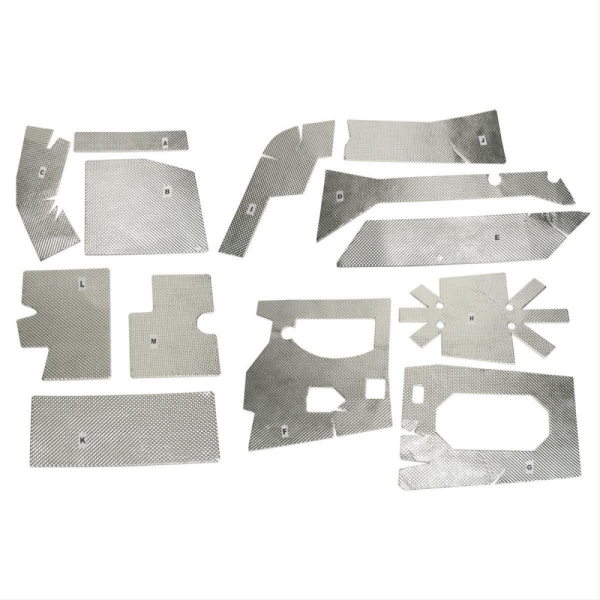
Die-cut parts are worth evaluating when the same coverage pattern is used repeatedly, when mounting holes must align with an assembly or when trimming around nearby components takes place during every installation. Typical requests include engine-cover barriers, bulkhead panels, localized heat shield patches and liners for industrial equipment covers.
For an early layout study, a rectangular blank may still be useful. Once the geometry is stable, compare the cost of a converted part with the complete in-house process: material handling, marking, cutting, removing scrap and inspecting the result. Die cutting should solve a defined assembly problem, not simply add a process to a one-off sheet.
This article concerns flexible sheet and mat components. A flat die-cut blank is different from a formed metal shield or an assembled three-dimensional cover. Identify which finished condition is required before requesting a quotation.
The material choice establishes what must be cut, handled and attached. Specify the reflective facing, insulating substrate, any interlayer bond and the mounting adhesive where used. Include the installed thickness available, rather than selecting each layer independently and checking fit afterward.
| Material starting point | What to define for the converted part |
|---|---|
| Adhesive-backed aluminum fiberglass heat shield mat | Reflective aluminum face, fiberglass layer, finished thickness and adhesive backing. Identify the bonding side and mounting-surface requirements. |
| Adhesive-backed aluminum silica heat shield barrier | Woven silica substrate, reflective facing and backing. Confirm the complete laminate specification rather than using the fiber rating as the finished-part limit. |
| Aluminum acoustic heat shield | Stitch-bonded glass-fiber needle mat, stamped or perforated foil facing and installed thickness. Specify any acoustic requirement separately from thermal protection. |
These are starting constructions for review. Cutting feasibility, backing details and the finished specification are confirmed for the chosen material. The wider heat barrier materials range provides additional sheet and mat options.
Provide a dimensioned drawing with units, a part number and a revision. Identify whether the view shows the reflective side or the adhesive side. A symmetrical outside contour can still contain an offset hole or an asymmetric backing detail, so orientation should be explicit.
Locate important features from defined reference edges, centerlines or mounting points. These references give the supplier and incoming inspector a common basis for checking the part. Where a digital cutting profile accompanies the drawing, state which document controls dimensions and resolve discrepancies before sampling.
| Drawing item | Information to show |
|---|---|
| Outside profile | Overall dimensions, curved sections, notches, corner details and critical coverage boundaries. |
| Holes and slots | Size, position and function: mounting, location, component clearance or service access. |
| Layer construction | Facing, substrate, backing and whether the stated thickness includes adhesive or release liner. |
| Orientation | Heat-facing side, bonding side, installation direction and left-hand or right-hand version where applicable. |
| Attachment areas | Approved fixing points, required adhesive coverage and any areas that must remain free of adhesive. |
| Dimensional acceptance | Feature-specific tolerances and the condition in which the flexible part is measured. |
| Edge requirements | Acceptable cut condition and any edge protection or reinforcement requested for review. |
A photograph or physical sample can help establish the layout, but it should not silently replace missing dimensions. For a replacement part, identify worn, stretched or damaged features that should not be copied. Agree a controlled drawing before production release.
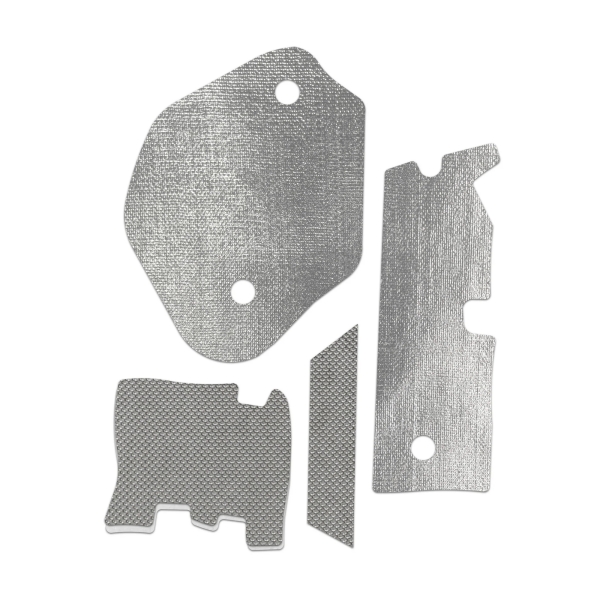
A mounting hole, an access opening and a free coverage edge do not necessarily need the same dimensional tolerance. Mark the features that determine assembly fit and explain what they locate. Avoid applying an unnecessarily tight general tolerance to every edge while leaving an important hole position undefined.
There is no single tolerance suitable for every die-cut heat shield material. Review the requested limits against the laminate, thickness, part size, feature geometry and proposed cutting method. BSTFLEX confirms achievable tolerances for the individual drawing; the term precision die cut is not a substitute for an agreed dimensional requirement.
For flexible parts, also define the inspection condition. State whether the material is checked lying flat without tension, with its liner attached or supported in an agreed fixture. Specify the thickness measurement method where compression affects the result. Stretching a part until its holes match a template should not be used to demonstrate compliance unless the approved inspection procedure expressly requires that installed condition.
Consider a panel barrier located by two mounting holes, with a larger opening around a connector. This is an illustrative drawing review, not a BSTFLEX dimensional specification.
The locating holes need agreed positions relative to the assembly references. The connector opening needs enough clearance for installation and service, while the outside edge needs to cover the specified hot zone. Separating these functions gives a clearer acceptance plan than assigning the same tolerance to all three features.
For an adhesive-backed die-cut heat shield, identify the actual mounting substrate and coating, expected temperature at the adhesive interface and environmental exposure. Confirm whether adhesive is intended across the full backing or only in specified areas. Selective adhesive coverage is a manufacturing requirement to review, not an assumed feature of every material.
Describe how the operator will handle and position the part. A release liner protects the adhesive before installation; its removal should not require pulling the flexible barrier out of shape. Special requests such as a split liner, extended liner edge or pull tab should be submitted during quotation so their feasibility can be confirmed for the chosen construction.
Keep adhesive and material approval separate from outline approval. An accurately cut part can still fail to bond to an unsuitable coating. Follow the selected backing's preparation and application instructions, and validate the bond on the intended surface.
Flag narrow bridges between openings, long unsupported tabs and small holes close to the perimeter. Review whether these features can be cut, packed and installed without damage. Where the design permits it, discuss a revised contour or additional support before approving tooling.
Define what is acceptable at the cut edge: loose fibers, damaged facing, adhesive transfer or layer separation should have an agreed inspection criterion. Requirements for sealed edges, reinforcement or additional finishing need separate confirmation. The phrase cut to drawing should not leave the supplier to guess which edge conditions matter in service.
Begin with the drawing check: outline, critical hole positions, thickness, layer orientation and cut quality. Then fit the sample to the intended panel using the proposed attachment method. Confirm that connectors, drains, inspection openings and removable covers remain accessible.
Run the thermal and durability evaluation required by the project. Record the relevant operating conditions and protected-side temperature, then inspect the attachment and laminate after exposure. Dimensional approval establishes fit; it does not establish heat resistance, adhesive durability or acoustic performance.
If an initial sample is made using a different process from the planned production method, identify that difference. A fit sample is useful for checking geometry, while approval for repeat supply should represent the agreed production construction and process.
The finished-part price depends on more than its outside length and width. Material specification, cutting layout, narrow features, internal scrap removal, required inspection and packing can all affect the work involved. Compare quotations against the same drawing revision, material and delivery format.
Separate prototype quantity, production batch size and expected annual demand. Identify any tooling or sample charges separately from the repeat-order unit price. Minimum order quantity and delivery timing are confirmed for the project rather than assumed from a generic sheet-product listing.
A lower material price does not necessarily mean a lower installed cost. Evaluate the amount of usable material, conversion work and assembly handling needed to deliver an accepted part.
For OEM supply, record the approved construction, drawing revision, inspection requirements and packaging instructions on the order. Define the label information and pack quantity so that similar-looking variants can be distinguished before installation.
BSTFLEX's custom cutting, die-cutting and packaging services include shaped components, holes, counted packing and labeling. Agree the final format for the selected part, including protection against bending, contamination or damage during transport.
When a material, backing, outline or installation condition changes, review the affected approval requirements. Reusing an old part number without recording the change makes it harder to establish which construction was tested and which version is being supplied.
A dimensioned sketch, template or existing sample can begin the review. Identify the installation requirements and any dimensions that are not yet known. Confirm the final drawing and acceptable file format before production.
The outline can be submitted for more than one candidate material, but each construction needs a feasibility and fit review. Thickness, flexibility, backing and edge behavior may require changes to the pattern or installation.
No. Die cutting defines the shape. Thermal suitability depends on the material construction and installed conditions, including the adhesive where used. A custom outline does not turn a panel-protection sheet into direct exhaust insulation.
Include the application, heat-source position, protected-side target, available clearance, material preference and attachment method. Add the drawing revision, critical tolerances, sample quantity and production forecast.
For finished shapes, start with the BSTFLEX die-cut heat reflective mat. For broader supply planning, review our heat barrier material manufacturing and OEM supply.
Send your drawing and operating requirements to BSTFLEX for material review, sample planning and a quotation for custom die-cut heat shields.

No.10, Chuangxin North Road, Nanshan Park, Ningguo Economic and Technological Development Zone, Ningguo City, Anhui Province, China
điện thoại/Whatsapp : 0086-15856303740
e-mail : sales@bstbraidedsleeve.com
Skype : vanesa-cheng